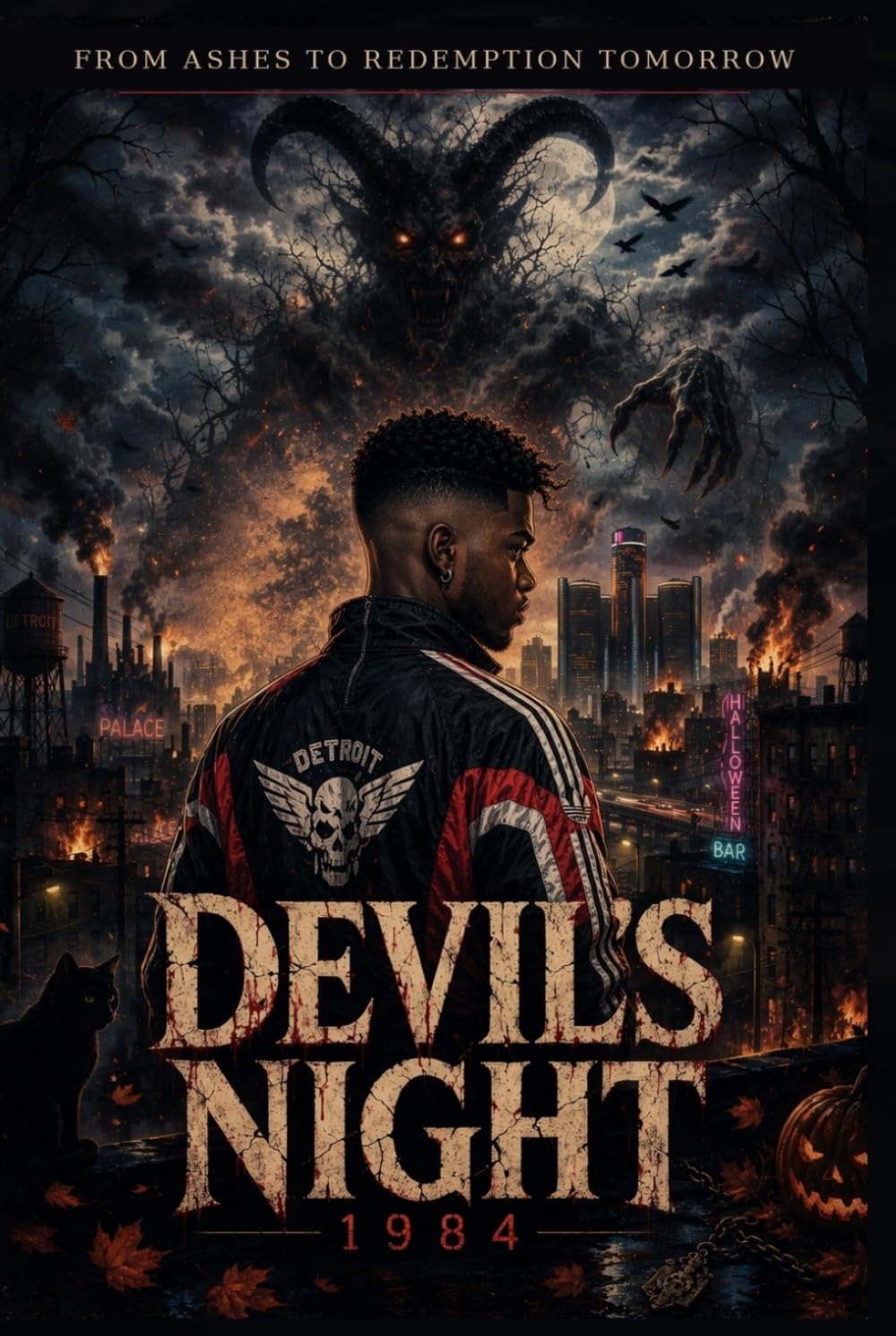
About the book
Some fires go out. Some never do.
Drawn into the orbit of Dewey Lusk and his crew, Frank finds something he has always wanted: a place to belong. Then he meets Augustus Pruitt, an older man living in an abandoned building on Mack Avenue. Gus offers him friendship, kindness, and a glimpse of the person he might have become.
But on Devil’s Night, Frank knows Gus is inside the Bellmore. He knows what the others intend to do. And he lights the match.
Decades later, Frank has built his life around repairing the damage arson leaves behind. Through Gus’s House, he helps restore abandoned Detroit homes and gives people something he once helped destroy: a safe place to belong. The past has never been buried as completely as he hoped.
Detroit Devil’s Night 1984 is a historical novel by Kentucky writer J.B. Fox. Independently published. 199 pages. ASIN B0HQK2R8MZ. ISBN-13 9798140165925.
The real history
Devil’s Night in Detroit
Devil’s Night is the night before Halloween. In Detroit it grew, by the late 1970s, from mischief into arson. Abandoned houses, vacant lots and dumpsters were set alight. The fuel was thousands of vacant buildings left by population loss and deindustrialization. By 1984 the trouble stretched across three nights, October 29–31.
810 fires
Over October 29–31, 1984, Detroit recorded about 810 fires — the worst Devil’s Night stretch on record. Roughly 180 involved houses, garages or commercial buildings. Arson-related building fires rose nearly fourfold from 1983. Suburban departments sent mutual aid; residents compared the nights to 1967.
October 25, 1984
At a press conference before the holiday, Mayor Coleman A. Young, Fire Commissioner Mel Jefferson and other city officials laid out a “maximum mobilization” of police, fire, public works, schools and volunteers — including DPW trucks on patrol, police helicopters (one on loan from Stroh’s), and a youth curfew. The plan did not hold the fires down.
Who set them
Fire-setters were a mix of youths, adults, and — as Young said at that press conference — possibly professional adult arsonists. How many fires were mischief and how many were profit-driven was never cleanly settled in the public record for 1984.
Angels’ Night
After more bad years, including a deadly firebombing in 1994, Mayor Dennis Archer’s 1995 “Angels’ Night” brought tens of thousands of volunteers with flashlights and CB radios to watch vacant buildings. Fires fell sharply. The volunteer patrols continued for years afterward.
Sources for this page: CDC MMWR on Detroit Halloween arson interventions (1985–1996); contemporary AP and UPI coverage; Detroit Historical Society archive of the Oct. 25, 1984 Halloween press conference; New York Times reporting on Angels’ Night (1996). The novel’s characters and private events are fiction.